The Engine Room Simulation Centre at the Nigerian Navy Institute of Technology (NNIT), Sapele, was commissioned by Vice Admiral Ezeoba (Rtd.) in 2013. The centre was established to provide Marine Engineering and Electrical Engineering personnel with practical training and operational experience similar to the conditions they may encounter onboard Nigerian Navy ships.
The centre provides trainees with the opportunity to perform practical exercises in a controlled and simulated environment. These practical exercises are referred to as “Tasks.” The tasks are generated and controlled by the instructor through the Instructor Desk, which serves as the central control point for all simulation activities.
Instructor Desk
The Instructor Desk is the central control unit of the simulation centre and serves as the operational brain behind the activities carried out during training. From the Instructor Desk, the instructor can launch or delete applications on individual simulation machines. The instructor can also launch applications on all the machines simultaneously, depending on the nature and requirements of the exercise.
There are thirteen (13) simulation machines, identified as MECH 1 to MECH 13. Each machine consists of a computer system with its corresponding display screen, allowing trainees to interact with and monitor the simulated machinery and systems.
Section A – Electrical Section in the Main Control Room (MCR)
Section A represents the electrical section of the Main Control Room (MCR). It provides practical training on the operation and management of electrical power generation and distribution systems onboard a naval vessel.
Trainees are taught how to start the shore generator or emergency generator, monitor the required operating parameters, and safely load the generator. The section also covers the operation of the air compressor, including the compression and supply of starting air required for starting the generators and main engines.
The section also contains the synchronizing panel, which provides practical training on how to synchronize and operate generators in parallel. Trainees are exposed to generator synchronization in Manual Mode, Semi-Automatic Mode, and Automatic Mode.
Section B – Marine Section in the Main Control Room (MCR)
Section B represents the Marine Engineering section of the Main Control Room. It focuses mainly on the operation, monitoring, and control of the ship's main propulsion machinery and associated systems.
Trainees are instructed on the correct procedures for starting the main engines and monitoring the essential operating parameters. These include temperature, pressure, engine speed, lubrication, cooling systems, and other relevant machinery indicators.
The section enables trainees to develop practical knowledge of main engine operation and understand the relationship between different machinery parameters during normal operation.
Section C – Display Section
Section C is the display and visualization section of the simulation centre. It provides a graphical representation of the major machinery and systems within the engine room.
The display comprises the layout of the generators, main engines, pipeline networks, valves, and other auxiliary machinery and equipment found within the engine room.
This section enables trainees to monitor the operation of various systems, understand the interconnection between machinery and pipelines, and identify the functions and locations of major components within the engine room.
Section D – Bridge
Section D represents the Bridge, where commands and operational instructions are carried out. The Main Control Room (MCR) is regarded as the local control station, where machinery is started, monitored, and prepared for operation.
When all machinery and associated systems are ready for operation, control can be transferred from the MCR to the Bridge after the machinery has been properly checked and certified by the appropriate engineering personnel, including the Marine Engineering Officer (MEO) and WEO. The arrangement provides trainees with practical knowledge of the relationship between the Bridge and the Engine Room, as well as the procedures involved in the transfer and control of machinery operations.
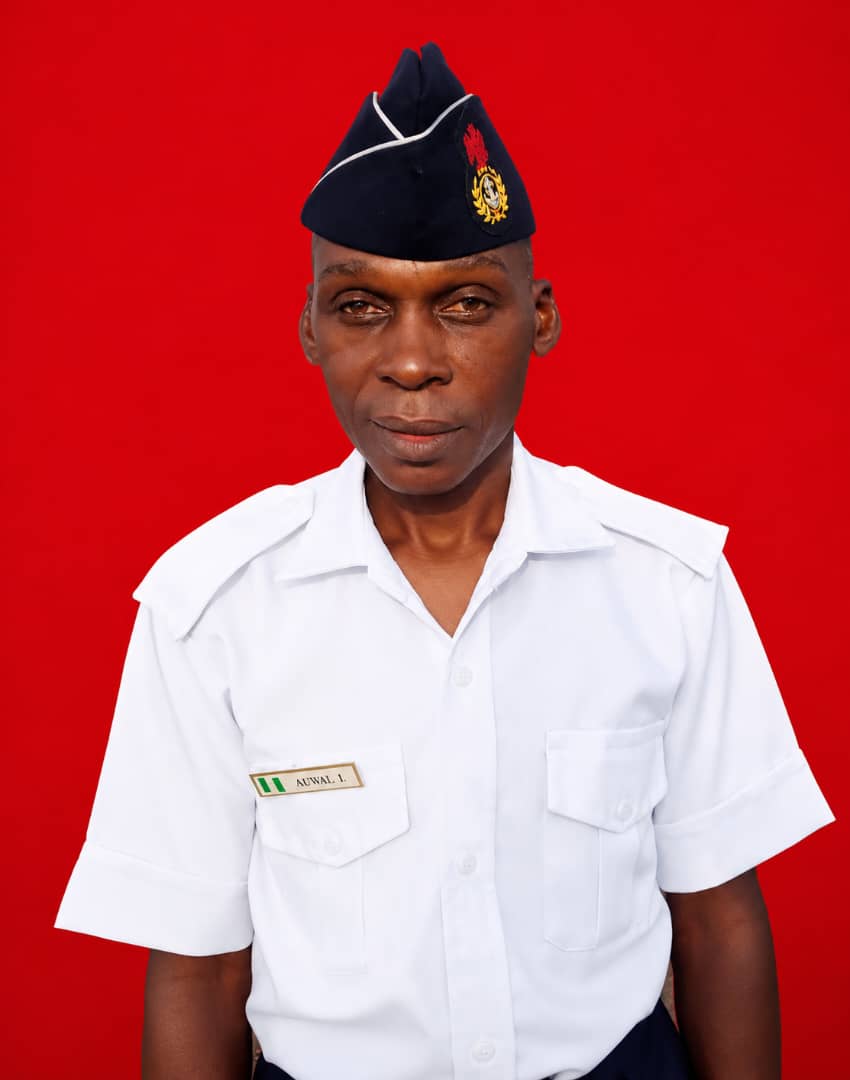
MWO Audu J.
Instructor